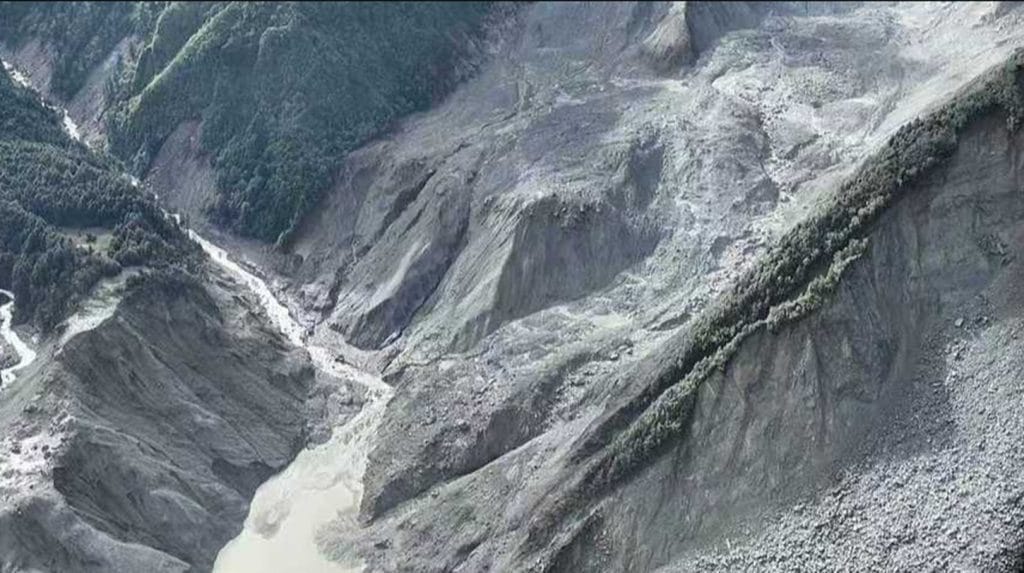
GYIRONG (Xizang), Aug 30 — An ice-rock avalanche originating from a high-mountain glacier in Nepal has been identified as the cause of the devastating mudslide that struck Gyirong Port in southwest China’s Xizang Autonomous Region on Aug 26.
A glacier on the southern slope of Mount Langtang Lirung in Nepal fractured at an altitude of approximately 5,200 metres, triggering a massive ice-rock avalanche, the regional government’s information office announced during a press conference on Sunday. The avalanche plunged rapidly to an altitude of around 4,000 metres, scouring the mountainside and developing into a debris flow that surged roughly 22 kilometres downstream before reaching Gyirong Port at an altitude of 1,800 metres.
The disaster flattened an area of about 0.7 square kilometres, destroying 27 buildings and related infrastructure. As of 6:00 pm on Saturday, the deadly mudslide had claimed 16 lives, while 546 people remain missing across the port area as emergency operations continue.
The scientific findings were made by a cryosphere emergency disaster response team from the Institute of Mountain Hazards and Environment under the Chinese Academy of Sciences. The team determined the cause by analyzing remote-sensing monitoring data and field-transmitted intelligence, supported by extensive on-site surveys.
–NMT




More Stories
Haze Has Not Impacted National Fishing Operations, Department Of Fisheries Confirms
521Kg Meth Seized In Laos Private Jet Did Not Originate From M’sia — Police
ASEAN Law Enforcement Cooperation Crucial in Tackling Transnational Crime