PUTRAJAYA, Aug 8 — Air quality in Malaysia has deteriorated significantly, with five districts in Sarawak recording unhealthy Air Pollutant Index (API) readings as of 8 am today due to cross-border haze originating from extensive hotspot activity in Kalimantan.
Department of Environment (DOE) Deputy Director-General (Development) Azuri Azizah Saedon revealed that the affected areas in Sarawak comprise Serian with an API reading of 171, followed by Kuching (154), Samarahan (154), Sri Aman (139), and Bintulu (124).
Of the remaining monitoring stations nationwide, three recorded good air quality while 60 registered moderate readings.
“Air quality in the country today has deteriorated, with an increase in the number of areas recording unhealthy API readings, especially in Sarawak, due to haze movement from various directions,” Azuri Azizah said in an official statement today.
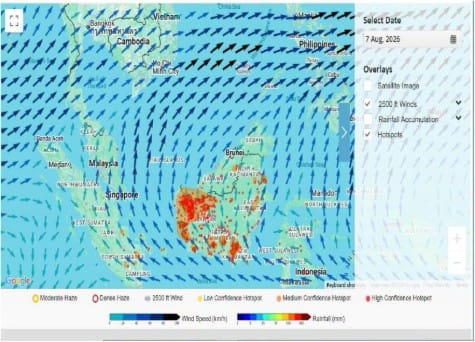
According to the Regional Haze Map released yesterday by the Singapore-based ASEAN Specialised Meteorological Centre (ASMC), dry weather conditions are expected to persist across most parts of the southern ASEAN region, except for isolated rain showers over northern Sumatra and Peninsular Malaysia, as captured by National Oceanic and Atmospheric Administration (NOAA)-20 satellite imagery.
Data from the ASMC detected a total of 643 hotspots in Kalimantan, 17 in Sumatra, and 25 within Malaysia—comprising 22 in Sarawak, two in Selangor, and one in Terengganu. Hotspots were concentrated extensively across West Kalimantan, alongside scattered occurrences in other portions of Kalimantan, Peninsular Malaysia, southern and central Sumatra, and eastern Java.
Satellite observations showed moderate to thick smoke plumes emanating from West Kalimantan drifting northwards directly into western Sarawak, alongside moderate to dense smoke plumes over other regions of Kalimantan and central Sarawak. Light to moderate smoke plumes were also observed over southern and central Sumatra as well as eastern Java.
In response to the deteriorating air quality, the DOE has intensified enforcement operations and daily patrols in high-risk open burning zones while both the National Open Burning Action Plan and the National Haze Action Plan have been activated to coordinate multi-agency mitigation efforts.
“The DOE, through the National Haze Action Plan, continuously monitors air quality and the measures to be taken are in line with the action plan involving all relevant agencies,” Azuri Azizah added.
Under the protocols of the National Haze Action Plan, the National Disaster Management Agency (NADMA) will activate Disaster Management Committees at the district, state, or central levels whenever API readings exceed 150 for more than 24 consecutive hours. Cloud seeding operations will also be executed subject to cloud suitability and weather conditions under the same threshold.
Standard operating guidelines dictate that all outdoor activities must be suspended when the API exceeds 100, while schools, kindergartens, and nurseries are mandated to close immediately if readings surpass 200.
The DOE deputy director-general issued a stern warning against illegal open burning, reminding landowners to prevent trespassing and unauthorized fires on their properties.
Under the Environmental Quality (Amendment) Act 2024, individuals convicted of open burning face mandatory minimum fines of RM25,000 up to RM1 million, imprisonment for up to five years, or both, alongside compounds of up to 50 percent of the maximum fine for each offense.
–NMT




More Stories
Five Long Lellang Helicopter Crash Victims Posthumously Awarded Sarawak State Honours
Cops Seize RM3.3 Million Worth Of Eramin 5 Pills At Kuching Airport, Two Arrested
Sarawak Drafting New Bumiputera Courts Bill To Restructure Customary Judicial System