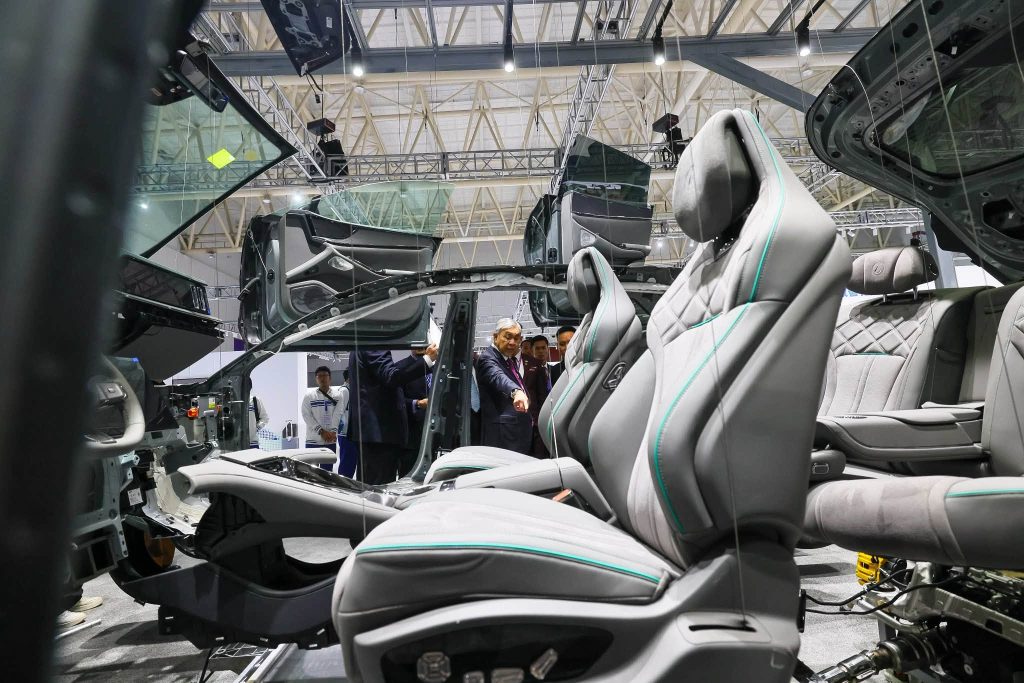
Photo : Zahid Hamidi FB
TIANJIN, Oct 17 – Deputy Prime Minister Datuk Seri Dr Ahmad Zahid Hamidi concluded a highly successful five-day working visit to China from October 12–16, 2026, significantly strengthening strategic cooperation between Malaysia and China across technical and vocational education, high-tech investment, security, and disaster management.
The delegation visit yielded expanded commitments in high-growth sectors, including artificial intelligence (AI), semiconductors, electric vehicles (EVs), nuclear technology, and the digital economy, reinforcing the bilateral relationship under the Malaysia-China Comprehensive Strategic Partnership framework.
A central priority of the visit was accelerating the development of the Malaysia-China Institute (MCI) as a premier platform for upgrading Malaysia’s Technical and Vocational Education and Training (TVET) ecosystem.
Through MCI, strategic Chinese industry partners will facilitate direct technology transfer and technical expertise in future-focused fields, such as smart manufacturing, robotics, EV manufacturing, and industrial digitalization.
Ahmad Zahid, who chairs the National TVET Council, underscored the implementation of the TVET 2.0 approach to bridge the gap between educational institutions, industrial needs, and job markets to ensure local skill development aligns with rapid technological shifts.
World TVET Council Proposal, Multi-Sector Agreements, and High-Level Bilateral Talks
During high-level conferences and ministerial meetings across Tianjin and Beijing, Malaysia advanced key international initiatives and bilateral accords:
- Proposal for World TVET Council: Delivering the keynote address at the 2026 World Vocational and Technical Education Development Conference (WVTEDC) in Tianjin on October 16, Ahmad Zahid proposed forming a World TVET Council to drive global skills integration, recommending that China host or manage its permanent secretariat.
- Mutual Accreditation Framework: At the WVTEDC Ministerial Roundtable, Malaysia proposed establishing a mutual qualification recognition framework and cross-border accreditation system, while expanding Train-the-Trainer programmes through MCI.
- Bilateral Economic Strategy: In a meeting with Chinese Vice-Premier Ding Xuexiang at the Great Hall of the People in Beijing on October 15, both nations agreed to renew the Investment Guarantee Agreement (ICA) and discuss expanding Renminbi utilization in ASEAN-China-GCC trade.
- Security and Transnational Crime MoU: Discussions with Chinese State Councillor and Minister of Public Security Wang Xiaohong on October 13 focused on finalizing a security Memorandum of Understanding (MoU) to combat online job scams and cybercrime, set to be signed during Prime Minister Datuk Seri Anwar Ibrahim’s visit to Shenzhen for the APEC Leaders’ Meeting in November.
- Disaster Management & Nuclear Research: Malaysia proposed leveraging China’s satellite monitoring and AI early-warning systems for climate risk preparedness, while holding talks with China National Nuclear Corporation (CNNC) to sponsor Malaysian students for nuclear science training and build local supply-chain readiness.
The bilateral visit reaffirmed joint aspirations toward building a High-Level Strategic Malaysia-China Community with a Shared Future, alongside China’s ongoing support for Malaysia’s full participation in BRICS.
–NMT


More Stories
Malaysian Armed Forces Reviews Volunteer Allowances To Boost Reserve Participation And Active Strength
Malaysia To Amend Laws To Impose Harsh Penalties On Cable Thieves Threatening Rail Safety
Unhealthy Air Quality Plaguing 24 Areas Nationwide as Pasir Gudang Nears Very Unhealthy Level