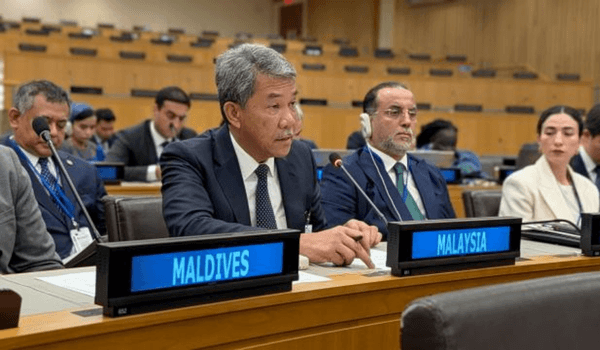
NEW YORK, Sept 25 – Malaysia has outlined three key strategic priorities to fortify global peacebuilding efforts: ensuring national ownership and inclusivity, translating the work of the Peacebuilding Commission into coordinated action, and strengthening national capacity and human capital.
Foreign Minister Datuk Seri Mohamad Hasan emphasized that peacebuilding must remain a continuous, proactive process focused on sustaining peaceful and inclusive societies, resilient communities, and stable economies.
“Peacebuilding must not wait until a conflict breaks out nor until it is over,” Mohamad said during his intervention at the Peacebuilding Commission Ministerial Meeting held at the United Nations headquarters on Thursday.
Mohamad, who is in New York leading Malaysia’s delegation to the 81st session of the United Nations General Assembly (UNGA 81) from Sept 23 to 27, stressed that commitments such as the 2025 Peacebuilding Architecture Review (PBAR) resolution must translate into tangible improvements in people’s daily lives.
Detailing Malaysia’s first priority, Mohamad stated that peacebuilding strategies must be nationally owned, meaningful, and inclusive.
“Malaysia therefore supports nationally owned prevention and peacebuilding strategies, complemented by preventive diplomacy and mediation,” he said, adding that peacebuilding frameworks must ensure the full, equal, and safe participation of women.
“This is the reason Malaysia hosted the 2025 ASEAN Women, Peace and Security Summit in Kuala Lumpur,” Mohamad noted, pointing out that the summit reaffirmed women’s leadership in peacebuilding, called for stronger protective measures, and integrated women’s security perspectives into emerging regional challenges.
On the second priority, the Foreign Minister urged for the Peacebuilding Commission’s work to translate directly into coordinated action, highlighting the symbiotic relationship between development and peace.
“Sustainable development can address the underlying conditions that fuel conflict, while stability enables development to take root,” Mohamad said.
He noted that Malaysia advocates for closer operational alignment between the Peacebuilding Commission and the Economic and Social Council (ECOSOC) to streamline development, humanitarian, and peacebuilding initiatives.
“This partnership is essential to ensure that international support is responsive to national priorities, mutually reinforcing and capable of delivering greater impact on the ground,” he added.
Addressing the third priority, Mohamad underscored the necessity of building long-term national capacity and human resources in conflict-affected regions.
He highlighted Malaysia’s ongoing technical assistance to developing and post-conflict nations through the Malaysian Technical Cooperation Programme (MTCP).
“Since 1980, more than 38,000 participants from 144 countries have benefited from the MTCP,” Mohamad said, concluding that peace remains a shared global responsibility requiring collective action among UN member states.
–NMT


More Stories
OIC Foreign Ministers Gather In Baghdad To Address Regional Crises And Advance Economic Integration
White House Press Secretary Katie Zacharia Resigns Following High-Profile Media Backlash
Morocco Appoints First Female Prime Minister Fatima Ezzahra El Mansouri To Lead Historic Four-Party Coalition