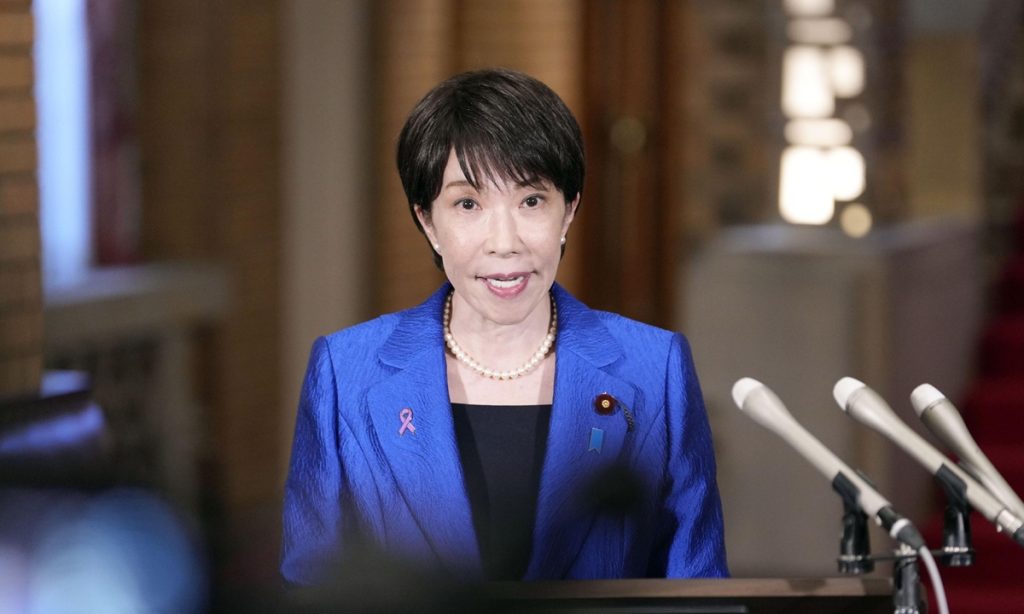
Japanese Prime Minister Sanae Takaichi meets the press at the premier's official residence in Tokyo on Nov. 16, 2026, before leaving for Manila to attend Association of Southeast Asian Nations-related meetings in the Philippine capital. (Photo by Kyodo News via Getty Images)
MANILA, Nov 17 – Japanese Prime Minister Sanae Takaichi is set to propose a new regional cooperative framework on oil security with Australia and most members of the Association of Southeast Asian Nations (ASEAN) on Tuesday, November 17, 2026, as persistent energy supply anxieties linger amid the prolonged West Asia conflict.
According to the Japanese government, Takaichi will advocate the establishment of the “Asia Oil Security Task Force” as a “voluntary body to advance cooperative efforts” during the Asia Zero Emission Community (AZEC) Leaders’ Meeting in Manila—a regional decarbonisation framework originally spearheaded by Tokyo.
Developed in collaboration with the Paris-based International Energy Agency (IEA) and the Jakarta-based Economic Research Institute for ASEAN and East Asia (ERIA), the initiative is designed to reinforce existing regional energy cooperation, specifically by enhancing emergency oil stockpiling preparedness and coordinating reserve releases.
Japanese government officials indicated that participating nations are expected to release a joint outcome document following the discussions. The AZEC gathering convenes on the sidelines of the 49th ASEAN Summit and Related Summits between the 11-member Southeast Asian bloc and its regional dialogue partners in the Philippine capital.
Strait of Hormuz Disruption and Strategic Reserve Context
Resource-scarce Japan—much like several ASEAN member states—relies heavily on crude oil imports from West Asia, though Tokyo maintains comparatively large strategic petroleum reserves.
Following the outbreak of the United States–Israeli war with Iran in February 2026—which effectively closed the Strait of Hormuz, a vital chokepoint for global energy shipments—Tokyo rolled out a US$10 billion financial support package in April to assist Asian nations with limited domestic oil stockpiles.
ASEAN comprises Brunei, Cambodia, East Timor, Indonesia, Laos, Malaysia, Myanmar, the Philippines, Singapore, Thailand, and Vietnam, though the regional bloc continues to enforce its policy of excluding Myanmar’s military junta from key summit meetings.
Initiative Scope, Institutional Partners, and Energy Security Backdrop
Key framework objectives, partner institutions, and geopolitical catalysts include:
- Proposed Initiative: “Asia Oil Security Task Force,” pitched by Japanese Prime Minister Sanae Takaichi as a voluntary body at the AZEC Leaders’ Meeting in Manila on Nov 17, 2026, involving Australia and participating ASEAN members.
- Core Focus & Partners: Strengthening emergency oil stockpiling preparedness and regional energy cooperation in partnership with the International Energy Agency (IEA) and the Economic Research Institute for ASEAN and East Asia (ERIA), culminating in a joint outcome document.
- Geopolitical Catalyst: Ongoing West Asia supply vulnerabilities triggered by the US–Israeli war with Iran in February 2026 and the resulting effective closure of the Strait of Hormuz, following Tokyo’s US$10 billion financial support scheme launched in April for Asian nations with limited oil reserves.
- ASEAN Participation: Involves Australia and most of the 11-member ASEAN bloc (Brunei, Cambodia, East Timor, Indonesia, Laos, Malaysia, the Philippines, Singapore, Thailand, and Vietnam), while Myanmar’s junta remains excluded from key ASEAN meetings.
–NMT
More Stories
Nokia Joins Four European Tech Firms To Build Cross-Border AI Gigafactory In Nordic-Baltic Region
APEC Outlines Four Policy Priorities To Bolster Regional Economic Resilience Amid Global Headwinds
Trump Signals Openness To Jensen Huang Returning As Nvidia CEO