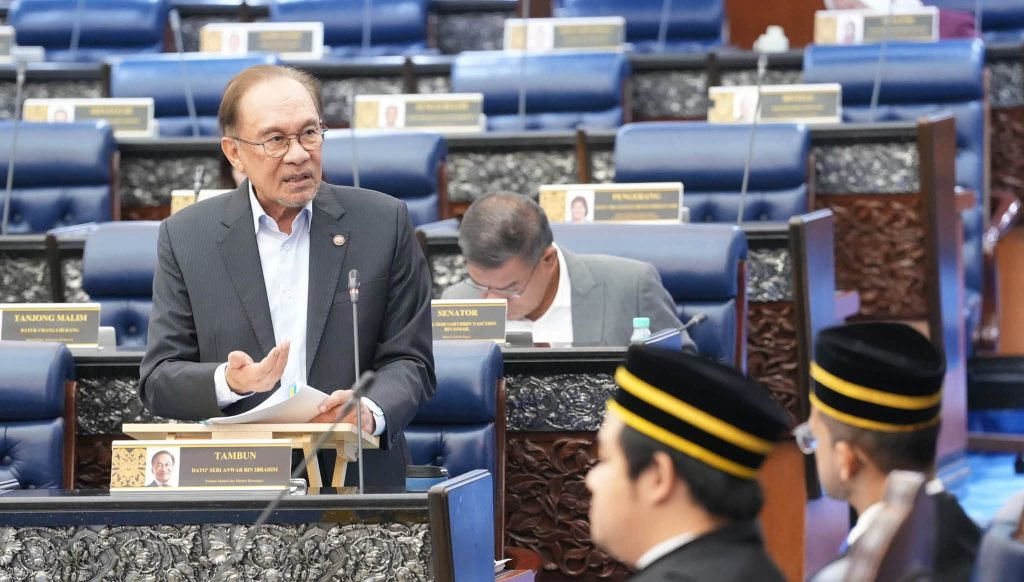
KUALA LUMPUR, Nov 3 – The Malaysian government has dismissed suggestions that the recent rise in large-scale drug smuggling is linked to the abolition of the mandatory death penalty, with Prime Minister Datuk Seri Anwar Ibrahim emphasizing that no such causal link has been established.
Speaking during Ministers’ Question Time in the Dewan Rakyat on Tuesday, November 3, 2026, PM Anwar stated that Malaysia’s existing legal framework remains stringent, and that the core vulnerability lies instead in security loopholes across the country’s land, sea, and air entry points.
“Is that (increase) really because we have reduced or abolished mandatory hanging? That has yet to be established because our borders are relatively porous, particularly along sea and land routes, and now even through the air,” Anwar explained. “That is why we are strengthening the Malaysian Border Control and Protection Agency (AKPS), because we know that smuggling is taking place on a large scale.”
The Prime Minister was responding to Hassan Abdul Karim (PH-Pasir Gudang), who inquired whether amending Section 39B of the Dangerous Drugs Act 1952 to remove the mandatory death sentence had emboldened trafficking syndicates to move larger drug volumes into the country without fear of mandatory execution.
To curb cross-border syndicates, Anwar highlighted the government’s commitment to fortifying border defense, announcing that AKPS’s budget allocation will experience a massive increase from RM37 million this year to RM490 million in 2027.
Regarding agency staffing, Anwar assured Parliament that the transfer of personnel to AKPS from existing frontline entities—including the Royal Malaysian Customs Department, Immigration Department, Ministry of Health, Malaysian Quarantine and Inspection Services Department (MAQIS), and Royal Malaysia Police (PDRM)—is being executed transparently by the Public Service Department (PSD) without coercion.
Addressing a proposal by Datuk Seri Dr Shahidan Kasim (PN-Arau) to second officers rather than rely on voluntary transfers, Anwar noted that while some officers have declined transfers, the majority accepted, and the deployment scheme adheres strictly to established public service guidelines.
The Prime Minister also commended PDRM’s Criminal Investigation Department (CID) and Narcotics Criminal Investigation Department (NCID) for their uncompromising enforcement actions against organized criminal networks.
Border Security Funding, AKPS Deployment, and Legislative Context
Key policy points, statutory frameworks, and operational details include:
- Policy Verdict: No established link between the abolition of mandatory death sentences under Section 39B of the Dangerous Drugs Act 1952 and increased drug trafficking volume.
- AKPS Funding Surge: Financial allocation for the Malaysian Border Control and Protection Agency (AKPS) expanding from RM37 million in 2026 to RM490 million in 2027.
- Inter-Agency Staffing Transfers: Voluntary PSD-managed recruitment drive absorbing officers from Customs, Immigration, Health Ministry, MAQIS, and PDRM into AKPS.
- Primary Cause Identified: High smuggling volumes attributed to border porosity across maritime, land, and aerial trade routes rather than altered judicial deterrents.
–NMT



More Stories
MCMC Removes Nearly 725,000 Gambling Contents, Blocks 2,603 Websites Through Joint Enforcement
Malaysia Decides Against Extraditing Dr Zakir Naik To India
MOE Opens Special Channel For PIBG Direct School Repair Applications Under RM2 Billion Allocation