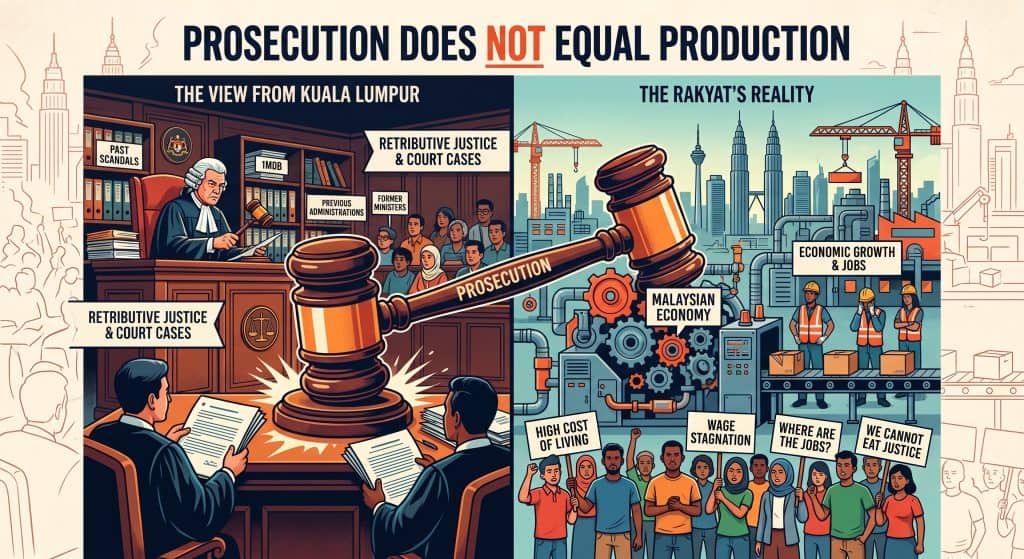
EDITORIAL – In the humid, bustling city of Kuala Lumpur, the question on every Rakyat’s lips is not about the verdict of a high-profile court case, nor about the political machinations of a bygone era. It is a far simpler, more visceral query: How much is a kilo of chicken today? Can I afford to fill my tank for the week? Will my children’s school fees leave me bankrupt by month’s end?
Yet, if one were to scan the headlines of Malaysia’s mainstream media, one would be forgiven for thinking the nation’s primary crisis is a moral one confined to the judiciary and the upper echelons of political power. The current administration, intoxicated by its own crusading rhetoric, remains visibly preoccupied with reopening old wounds, prosecuting political adversaries for historical misdeeds, and re-litigating the scandals of the past decade.
While the pursuit of justice is a pillar of a mature democracy, the current execution of these anti-corruption drives has devolved into a reactive, performative spectacle—more so with the advent of the “corporate mafia” and other allegations of executive overreach and abuse of power by the authorities. This is doing little to restore fractured public confidence, and absolutely nothing to alleviate the suffocating economic pressures weighing down the Rakyat. The government stands at a precipice; it can continue to look backward into the rearview mirror of history, or it can grasp the steering wheel and drive Malaysia forward through structural reforms that genuinely uplift its citizens.
The Weight of the Present: A Reality Check
Before dissecting the futility of these prosecutions, one must acknowledge the severity of Malaysia’s current economic condition. The ringgit has struggled against a resurgent US dollar, trading near historic lows, making imports more expensive and eroding the real wages of the middle class. The recent rationalization of diesel subsidies, while fiscally necessary in theory, was executed with a bluntness that sent shockwaves through the logistics and agricultural sectors, triggering a cascade effect on the cost of basic goods.
Furthermore, we are witnessing a silent hemorrhage of talent. The brain drain—whereby Malaysia’s brightest engineers, doctors, and financiers seek refuge in Singapore, Australia, or the UK—is not driven by a lack of patriotism, but by a lack of opportunity and economic certainty. The manufacturing sector is stuck in a “middle-income trap,” unable to transition from assembly-line dependency to high-value research and development. Small and Medium Enterprises (SMEs), which form the backbone of the Malaysian economy, are suffocating under bureaucratic red tape and rising operational costs, with little to no immediate relief from the central government.
In this climate of existential economic anxiety, the government’s primary energy seems consumed by the courts. The trials of former Prime Ministers, the revisiting of the 1MDB saga, and the ongoing investigations into various political allies and foes represent a reactive form of governance. It is governance as a morality play, rather than governance as an economic engine.
The False Promise of Reactive Prosecutions
Let us be clear: accountability is not inherently bad. Corruption is a cancer that has historically eaten away at Malaysia’s potential. However, the current approach is flawed on three fundamental levels.
First, the timing and selective nature of these prosecutions breed cynicism rather than confidence. When the legal machinery appears to move with excessive vigor against political opponents while moving sluggishly on cases involving the current ruling coalition’s allies, the public does not see justice; they see political weaponization. This perception erodes the very trust the government claims to be restoring. International investors, who are the lifeblood of our economic growth, view political instability and legal vendettas as massive red flags. They do not care if a politician from a decade ago is guilty; they care if the regulatory environment today is stable enough to protect their capital.
Second, these actions are resource-draining. The amount of administrative, judicial, and prosecutorial bandwidth consumed by these historical cases is staggering. The Attorney General’s Chambers, the Malaysian Anti-Corruption Commission (MACC), and the police are finite resources. By focusing their lens almost exclusively on the rearview mirror, they are diverting attention and resources away from proactive enforcement. Where is the task force dedicated to tackling the cronyism in government-linked companies (GLCs) that is happening today? Where is the proactive monitoring of procurement fraud in post-pandemic recovery projects? By staring at the past, the government is blinding itself to the corruption of the present.
Third, and most crucially, these prosecutions do not put food on the table. They do not lower the price of rice. They do not create high-skilled jobs for the 400,000 fresh graduates entering the job market annually. When a family in Pahang struggles to pay their utility bills, the televised court proceedings of a former minister are an irrelevant distraction. The government appears to be fighting ghosts while the living are struggling. This is the epitome of reactive governance—responding to the scandals of yesterday instead of proactively engineering the prosperity of tomorrow.
The Proactive Prescription: Reforms and Incentives that Matter
If the government wishes to restore genuine confidence, it must pivot its entire machinery from prosecution to production. The Rakyat needs a government that acts as an economic catalyst, not a punitive tribunal. The path forward requires a radical shift in focus toward four key pillars of proactive reform:
Wage-Led Growth and Productivity Reforms – Malaysia suffers from a structural defect: wages have stagnated relative to productivity for over a decade. The government must move beyond the minimum wage rhetoric and introduce fiscal incentives that actively penalize companies relying on cheap foreign labor while rewarding those that upskill local talent. It is time for a comprehensive “Wage Transformation” policy, where tax rebates are tied directly to salary increases for local employees.
Targeted Subsidy Rationalization with a Safety Net – We are not opposed to subsidy rationalization; we are opposed to its cruel execution. The government must cease the blanket removal of subsidies and replace them with a “Progressive Digital Allowance.” Instead of defending court cases, the bureaucracy should be building a robust, secure digital database to channel fuel, cooking oil, and electricity subsidies directly into the accounts of B40 and lower M40 households. This is a proactive solution that plugs leakages without crushing the poor.
Deregulation for SMEs – Malaysian entrepreneurs are drowning in red tape. To start a business, secure a license, or export goods requires navigating a labyrinth of overlapping ministries. The government should declare a “Regulatory Moratorium” on new business restrictions and aggressively digitize all licensing processes via a single, unified portal with guaranteed turnaround times. This proactive easing of business friction would stimulate local entrepreneurship and attract foreign direct investment (FDI) that is currently bypassing Malaysia for Vietnam and Indonesia.
Future-Proofing Human Capital – Finally, we must stop treating education as a political football. The government must proactively partner with global tech giants and vocational institutes to create a national “Reskilling Voucher” program. Every Malaysian worker over the age of 30 should be given a significant financial credit to enroll in certified courses in AI, data analytics, green energy, and advanced manufacturing. This is a direct benefit to the Rakyat—it empowers them to escape the middle-income trap and seize the jobs of the future, rather than relying on the protected, low-value sectors of the past.
The Choice Between a Perception of Justice and Survival
Malaysia does not have to choose between justice and economic growth. But it must choose between a reactive justice that serves political egos and a proactive governance that serves the national interest. The obsession with prosecuting politicians for past misdeeds has become a costly indulgence. It is a luxury the Rakyat can no longer afford.
The confidence of the people will not be restored by the gavel of a judge, but by the resilience of their wallets. The government must recognize that its legacy will not be defined by how many former leaders it managed to convict, but by whether it managed to lift the average Malaysian out of the anxiety of inflation and into the security of a stable career.
It is time to close the chapter on the past and begin writing a new one. A chapter focused on reforms that actually reform, and incentives that actually incentivize. The Rakyat is watching, and they are hungry—not for justice theater, but for economic oxygen. The government must give it to them, and fast.
–NMT


More Stories
Bursa Malaysia Opens Moderately Higher Ahead Of Budget 2027 Tabling
Bursa Malaysia Extends Losses As Rising Oil Prices And Geopolitical Risks Weigh On Sentiment
Malaysian Content Creators Highlight Sports Passion At Inaugural Local TikTok Clubhouse