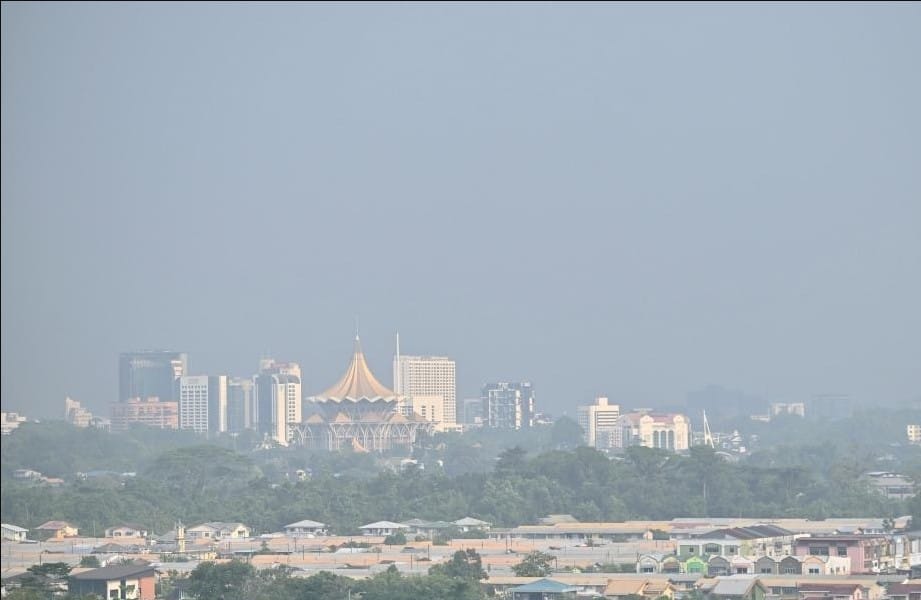
KUALA LUMPUR, Aug 13 — Haze conditions currently blanketing multiple parts of Malaysia are unlikely to show any significant improvement over the next three to five days, as light rainfall forecast across affected regions will not be sufficient to clear suspended atmospheric particles on a large scale.
According to the Malaysian Meteorological Department (MetMalaysia), dry atmospheric conditions driven by the ongoing Southwest Monsoon continue to aggravate forest fires and transboundary smoke movement, prolonging poor air quality in both East and Peninsular Malaysia.
Speaking during an interview on Bernama TV’s Focus 15: Cross-Border Haze Threat, National Weather and Earthquake Operations Centre (POCGN) Senior Director Maqrun Fadzli Mohd Fahmi explained that while localized showers are expected, they will fall short of completely washing away the dense smog.
“From the information we have so far, we have not seen a major change in the situation. We expect the situation to remain almost the same and in the next few days, there will be a little rain compared to the current dry conditions,” Maqrun Fadzli stated.
“We hope the rain will help, but if the air is very hazy, a little rain may not be able to remove the effects of the haze,” he added.
The severity of the smog has been particularly pronounced across western and southern Sarawak, where worsening air pollution prompted the closure of over 100 schools in the Serian district yesterday. In Peninsular Malaysia, hazy conditions have increasingly affected urban centers, including the Klang Valley and Penang.
Maqrun Fadzli identified the Southwest Monsoon—which typically lasts from May to September—as the primary climate driver behind the dry weather pattern and reduced precipitation nationwide.
“When we don’t get much rain, the weather will be hotter and this hot weather contributes to the risk of burning. From the burning, smoke and what we call haze are produced,” he noted.
To track the evolution of the smog, MetMalaysia is continuously monitoring environmental hotspots using high-resolution satellite imagery to pinpoint active forest fires. By integrating real-time satellite data with wind vector modeling, meteorologists are projecting the trajectory of smoke plumes and suspended particulates to identify high-risk areas and issue early advisories.
Authorities have strongly urged the public to refrain from any form of open burning and to limit prolonged physical exertion outdoors to mitigate health risks associated with deteriorated air quality.
Data retrieved from the Air Pollutant Index Management System (APIMS) portal this afternoon showed 10 locations registering unhealthy Air Pollutant Index (API) readings. The affected areas include Samarahan, Serian, Kuching, Sri Aman, Sarikei, Mukah, and Sibu in Sarawak, alongside Johan Setia in Selangor, Cheras in Kuala Lumpur, and Minden in Penang.
–NMT




More Stories
Nationwide Haze Worsens As 27 Areas Register Unhealthy API Levels On October 19
Storm Evacuation Figure Holds Firm At 55 Victims In Larut, Matang And Selama
Air Quality Deteriorates As Pasir Gudang Hits ‘Very Unhealthy’ API Level