

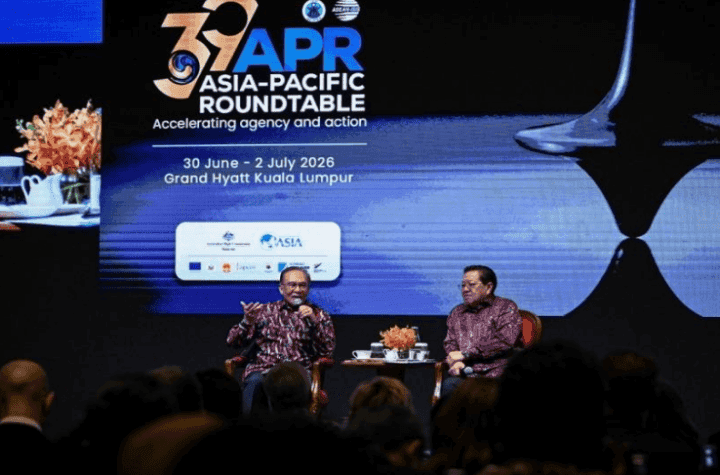
KUALA LUMPUR, July 2 — Prime Minister Datuk Seri Anwar Ibrahim has rejected the notion that a military conflict in the South China Sea is bound to happen, reinforcing that open dialogue, mutual trust, and a strict commitment to international law remain the true keys to sustaining regional stability.
Speaking during a question-and-answer session at the 39th Asia-Pacific Roundtable on Thursday, Anwar highlighted that Malaysia continues to hold constructive and highly positive engagements with Beijing, even while navigating overlapping maritime claims in the area.
“I personally don’t share this phobia about the potential threat to the South China Sea. Yes, there are issues, but thus far, Malaysia’s position and experience has been very, I should say, meaningful exchanges with China.
“I’ve talked about it to President Xi Jinping, to Premier Li Qiang, but the relations have been excellent. There has not been one major question or issue that would cause tension,” he stated.
Commitment to Frameworks and ASEAN Diplomacy
Anwar pointed out that China has voiced its support for the United Nations Convention on the Law of the Sea (UNCLOS) alongside the continuing negotiations for the ASEAN-China Code of Conduct in the South China Sea. These frameworks, he added, must remain the primary guideposts for resolving friction peacefully.
The Prime Minister also warned against security narratives that focus too heavily on the prospect of regional warfare, urging ASEAN to stay firmly anchored in diplomatic paths. Moving forward, Malaysia and its ASEAN neighbors intend to persist in pushing for institutional reforms within major global bodies, including the United Nations and the World Trade Organisation.
Anwar attributed ASEAN’s long-standing track record of regional peace to the deep, personal connections among its leaders. He noted that direct, regular communication allows heads of state to iron out disagreements and manage differences before they have a chance to escalate.
Turning to the Cambodia-Thailand border dispute, Anwar commended both nations for their shared dedication to continuing their bilateral negotiations. He characterized many of the region’s current border friction points as historical artifacts left behind by the colonial era, expressing firm confidence that steady dialogue and institutional trust will eventually lead both parties to a peaceful resolution.

More Stories
Timor-Leste To Be Made Full Member Of ASEAN On Oct 26 – PM Anwar
ASEAN Summit: Temporary And Phased Traffic Diversions From Oct 23
PM Anwar Shares Coincidental Meeting With North Korean Leader Kim Jong Un In China