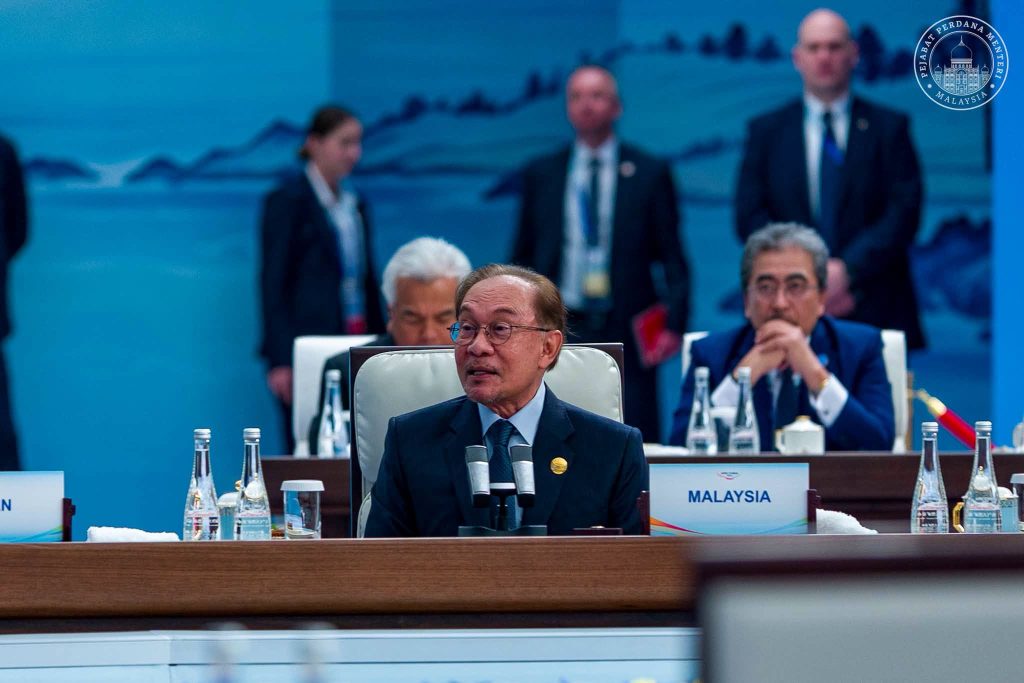
YAB Perdana Menteri, Dato' Seri Anwar Ibrahim semasa di Mesyuarat Pemimpin Ekonomi APEC Ke-33 di Shenzhen, China. 19 November 2026. IZZUDDIN ABD RADZAK/Pejabat Perdana Menteri. NO SALES; NO ARCHIVE; RESTRICTED TO EDITORIAL USE ONLY. NOTE TO EDITORS: These handout photographs are provided solely for editorial reporting purposes and may be used only for the contemporaneous illustration of the events, subjects, individuals depicted, or facts referenced in the accompanying caption. Any further reuse may requir
SHENZHEN, Nov 19 – Malaysia has reaffirmed its steadfast commitment to open trade, multilateralism, and deeper regional economic integration in the face of escalating geopolitical tensions and global economic fragmentation, Prime Minister Datuk Seri Anwar Ibrahim said on Thursday, November 19, 2026.
Delivering Malaysia’s country statement at the 33rd Asia-Pacific Economic Cooperation (APEC) Economic Leaders’ Meeting (AELM) at the Shenzhen International Communication Centre (SICC), Anwar stressed that economic openness remains indispensable to Malaysia as a trading nation.
“We must strengthen the rules-based multilateral trading system, deepen regional economic integration and ensure that trade remains an instrument of opportunity, not division,” he told fellow Asia-Pacific leaders.
Anwar emphasised that regional economies must stay anchored to cooperation and integration to sustain growth and shared prosperity amid an increasingly uncertain global environment. Defining shared prosperity as creating quality jobs, uplifting livelihoods, and enabling meaningful public participation in economic progress, he urged member economies to harness artificial intelligence (AI) responsibly.
“Innovation must serve as a bridge to shared prosperity. As artificial intelligence transforms our economies, technological advancement must empower our people and uphold their dignity,” he said.
Building Collective Resilience and Cybersecurity
Highlighting how swiftly geopolitical friction, energy insecurity, and climate-related disruptions can undermine livelihoods across the Pacific Rim, Anwar stressed that collective prosperity must go hand in hand with institutional and digital resilience—including an unflinching commitment to cybersecurity.
“The strength of our Asia-Pacific community should not be measured solely by the growth we generate, but by the opportunities we create, the inequalities we reduce and the resilience we build together,” he added.
APEC’s Global Footprint and Membership Milestones
Established as an intergovernmental forum for 21 Pacific Rim member economies promoting free trade across the Asia-Pacific, APEC represents nearly 40 percent of the world’s population, almost half of global trade, and over 60 percent of the global economy.
Malaysia is one of APEC’s 12 founding members (1989), alongside Australia, Brunei, Canada, Indonesia, Japan, South Korea, New Zealand, the United States, the Philippines, Singapore, and Thailand. China, Hong Kong, Taiwan, Mexico, and Papua New Guinea acceded in 1993, followed by Chile in 1994, and Peru, Russia, and Vietnam in 1998, bringing total membership to 21 economies.
Country Statement Pillars, AI & Resilience Agenda, and APEC Membership Overview
Key policy messages, strategic priorities, and forum facts include:
- Open Trade & Multilateralism (Nov 19, 2026): Speaking at the 33rd APEC Economic Leaders’ Meeting at SICC in Shenzhen, Prime Minister Datuk Seri Anwar Ibrahim called for strengthening the rules-based multilateral trading system and deepening regional integration so trade serves as an instrument of opportunity rather than division.
- Inclusive Innovation & Resilience: Anwar urged economies to ensure artificial intelligence empowers people and upholds human dignity, while pairing shared prosperity with resilience against geopolitical shocks, energy insecurity, climate challenges, and cyber threats.
- APEC Scale & Membership: Representing nearly 40% of global population, almost half of world trade, and over 60% of global GDP across 21 economies (12 founding members including Malaysia in 1989; expansions in 1993, 1994, and 1998).
–NMT


More Stories
Meta Pauses New Non-Voting Share Structure Amid Delaware Shareholder Lawsuit
France Ready To Help Malaysia Build Sovereign Defence Capabilities, Says Mohamed Khaled
US President Donald Trump And Russian President Vladimir Putin Hold Bilateral Talks In Shenzhen On Sidelines Of 33rd APEC Summit