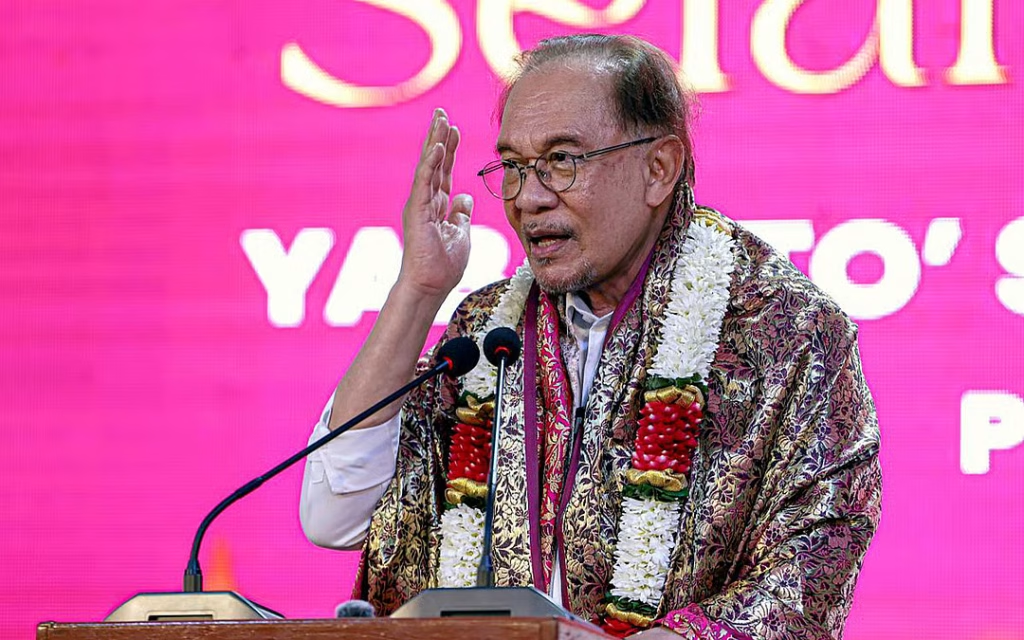
KUALA LUMPUR, Nov 12 – Prime Minister Datuk Seri Anwar Ibrahim affirmed on Thursday, November 12, 2026, that the government’s refusal to reintroduce the Goods and Services Tax (GST) is driven by a commitment to protect low-income citizens from cost-of-living burdens rather than political motives.
Speaking during the Minister’s Question Time (MQT) session in the Dewan Rakyat, Anwar—who also serves as Finance Minister—stated that reinstating a broad-based consumption tax while household incomes remain low is not economically viable.
Replying to a supplementary question from Datuk Seri Dr Ronald Kiandee (PN-Beluran), Anwar stressed that the government remains open to refining the existing Sales and Services Tax (SST) framework—including resolving industry complaints over double taxation—without reverting to GST.
“I am not dogmatic when it comes to economics. The system remains SST, but if we can make one or two adjustments to improve it, why not?” Anwar told the House.
“I am firmly against the GST. It’s not about politics. What is political about choosing what benefits the national economy and the people? GST is a tax imposed on everyone. The SST is a tax levied on businesses. I choose to tax businesses instead,” he declared.
RM4,000 Income Benchmark and Business Lobbying Concerns
Anwar outlined that any future review of GST implementation can only be considered once the public’s minimum income reaches at least RM4,000 per month, ensuring that broad-based taxation does not disproportionately strain lower-income households. He noted that current income levels remain low, while government efforts to raise minimum wages have faced resistance from certain business groups.
The Prime Minister also addressed corporate lobbying from previous Budget dialogue sessions, asserting that large business owners favor GST because it allows them to shift tax liabilities down the supply chain directly onto consumers.
“If you look at the discussions, all the tauke (big businessmen) and business owners want GST. They must have a reason for wanting it. It is convenient for them. So, they can shift the tax burden, they do not have to bear it, but those further down the chain will have to. That is my major issue with it (and why I disagree),” Anwar explained.
Responding to a separate supplementary query from Datuk Awang Hashim (PN-Pendang) regarding supply chain taxation efficiency, Anwar acknowledged that SST carries certain weaknesses—such as profiteering by unscrupulous traders—requiring active price monitoring and enforcement to safeguard consumers. He added that monitoring and enforcement challenges under a reinstated GST system would similarly risk inflating consumer prices.
Fiscal Policy Stance, Income Thresholds, and Tax Comparison
Key parliamentary statements, economic benchmarks, and tax policy differences include:
- Executive Position: Firm rejection of GST reintroduction in favor of retaining and refining the Sales and Services Tax (SST).
- Minimum Income Condition: GST will only be considered when Malaysians’ minimum monthly income reaches at least RM4,000.
- SST Refinement Commitment: Government is open to targeted SST adjustments to eliminate double taxation issues raised by businesses.
- Tax Incidence Distinction: SST levies taxes primarily at the business level (with ~2,000 exempted goods/services and revenue at 3.2% of GDP), whereas GST taxes all consumers broadly across the supply chain.
- Enforcement Focus: Ongoing price monitoring required under SST to prevent trader profiteering and protect low-income households.
–NMT

More Stories
Malaysia Selects Turkiye As Preferred Alternative Missile Supplier For RMN Littoral Combat Ships
Pahang Ruler Advises Residents To Stay Alert And Prioritize Safety Amid Monsoon Rains
Fiscal Resilience, Taiwan Investment Talks, And Najib House Arrest Terms Dominate Dewan Rakyat Agenda